
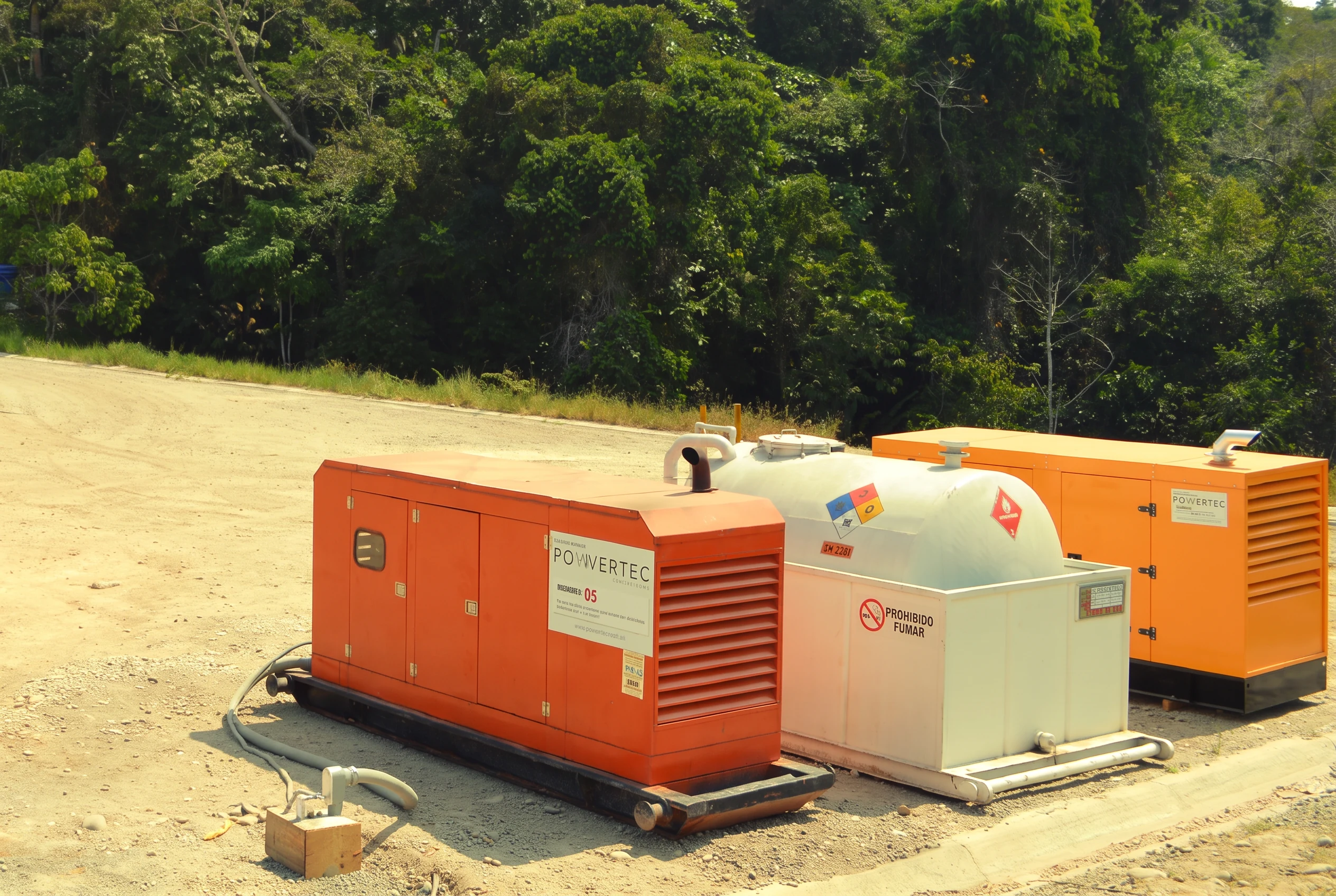
The most common question when buying or renting a generator set is also the riskiest to answer over the phone: "how many kW do I need?" An undersized unit shuts down at the worst possible moment; an oversized one costs more, burns fuel inefficiently and ages poorly from running at very low loads. This guide summarizes the engineering method applied in the field.
First: survey the real load
The starting point is a load inventory: every piece of equipment that must run during an outage, with its rated power, whether it is single-phase or three-phase, and whether it starts with an electric motor. Powering lighting and servers is not the same as powering pumps, compressors or elevators.
Also distinguish between total installed load and critical load. In many operations backup only covers what's essential —product refrigeration, active processes, safety lighting, data systems— which considerably reduces equipment size and fuel cost.
From kW to kVA: the power factor
Generators are sold in kVA (apparent power) with a reference power factor of 0.8. The practical relationship is: usable kW = kVA × 0.8. A 100 kVA generator set delivers approximately 80 kW of real power.
If your inventory shows 150 kW of critical load, the initial calculation is 150 / 0.8 = 187.5 kVA, before applying the margins and corrections explained below. Confusing kW with kVA is the most common sizing error and almost always leaves the equipment undersized.
Motor starting peaks
An electric motor demands between 3 and 7 times its rated current for a few seconds on startup. If the generator cannot sustain that peak, voltage drops and the motor either fails to start or trips the unit's protections.
Common techniques to manage this include staggering the startup of large motors, using soft starters or variable-frequency drives, and sizing the generator considering the largest motor starting while the rest of the load is already connected. In systems with multiple motors, starting order matters as much as total power.
Correction for altitude and temperature
Diesel engines lose power as the air thins and ambient temperature rises. As a general reference from the ISO 8528 standard and manufacturers' curves, derating is on the order of 10% for every 1,000 m of altitude above sea level beyond reference conditions, with additional reductions for temperatures above 25-40°C depending on the engine.
The practical effect in Colombia is direct: a unit that delivers 400 kVA at sea level does not deliver the same in Bogotá (≈2,600 m.a.s.l.) as it does in Barranquilla at 35°C. That's why the same load can require a different generator depending on the city, and final sizing must be calculated with the site's real conditions.
Operating margin and duty class
Recommended practice is to run the generator between 70% and 85% of its continuous rating: enough reserve for load variations, without falling into prolonged operation at very low load, which in diesel engines causes carbonization and cylinder glazing (known as wet stacking).
You also need to declare the duty class per ISO 8528: continuous power (COP) for unlimited operation, prime power (PRP) for prolonged use with variable load, and standby power (LTP/ESP) for occasional backup. A unit offered as standby power should not be used as a primary source: capacities typically differ by 10-25%.
Quick example
- Measured critical load: 180 kW real.
- Conversion to kVA: 180 / 0.8 = 225 kVA.
- Starting peak of the largest motor: requires ≈20% extra → 270 kVA.
- Altitude correction (Bogotá) and 80% operating margin: ≈340-400 kVA.
- Frequent decision: two 200 kVA units in N+1 configuration if continuity is critical.