
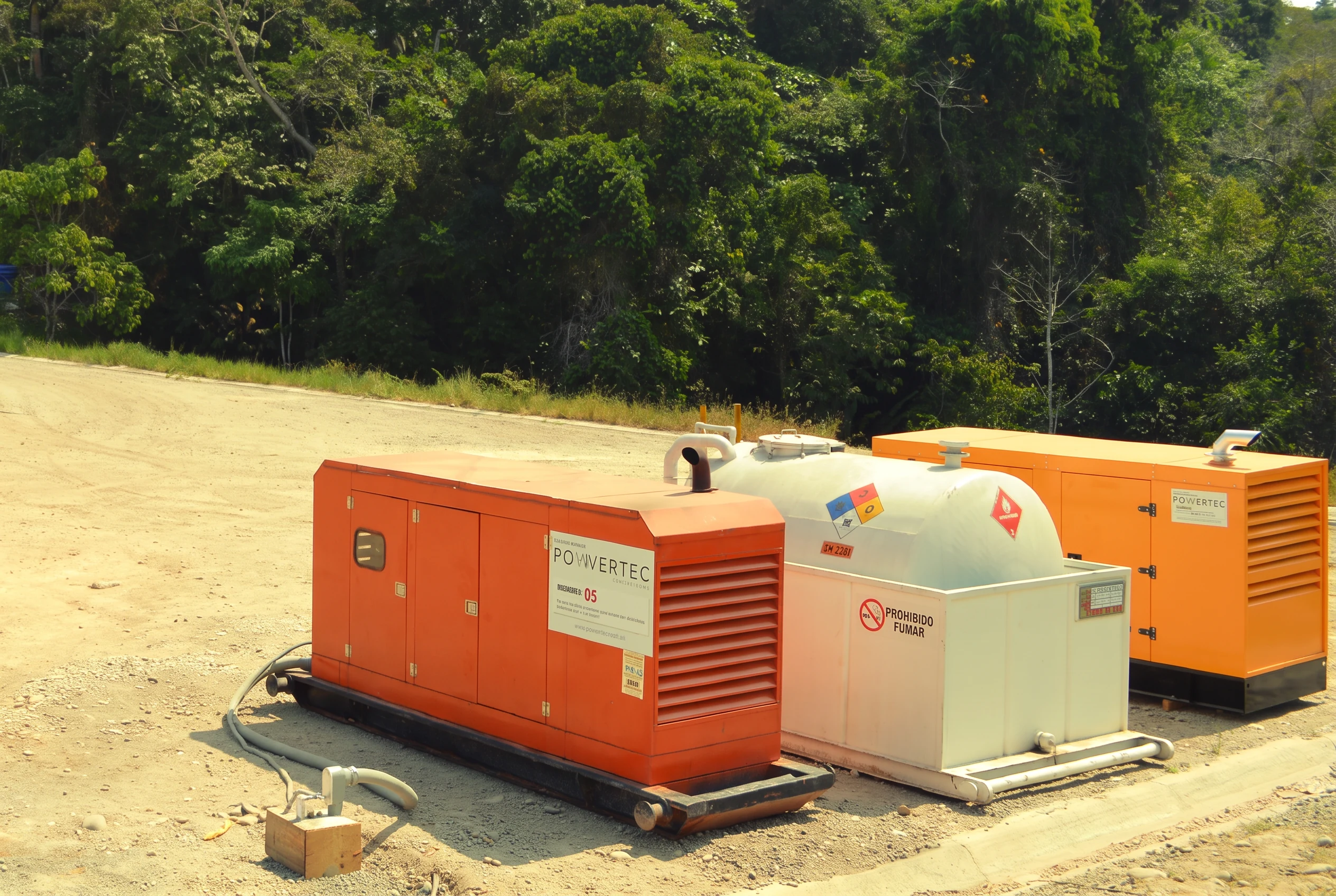
An electrical continuity plan is not just buying a generator: it is deciding what must keep running, for how long, and with what level of tolerable interruption. With active rationing alerts and a spot price that in July 2026 was 475.6% higher than the year before, this exercise is best done before the dry season, not once the outage schedule has already been published.
1. Classify the loads
Backing up only what is critical and essential reduces the power required and fuel consumption, and is often the difference between a viable project and an oversized one.
Classification should come from a survey with real data —measured amperages, not just nameplates— and with process owners involved. It is common for the sum of installed power ratings to far exceed real simultaneous demand: measuring before buying avoids paying for kilowatts that will never be used.
- Critical: safety, cold chain, continuous processes, servers and control systems.
- Essential: operational lighting, pumping, compressed air.
- Deferrable: administrative and comfort loads that can be shut down during the outage.
2. Size with technical margin
Sizing must account for continuous power, motor starting, power factor, and altitude/temperature correction — a decisive point in cities like Bogotá, located at around 2,600 m.a.s.l.
Derating curves vary by manufacturer and engine technology, but the usual industry reference is a power loss on the order of 1% for every 100 m above sea level beyond a certain design altitude, plus the correction for ambient temperature. That's why a unit that delivers its full rated kW at sea level can deliver notably less on the Bogotá savanna if it was not specified with that margin.
- Define usable kW and convert to kVA using the plant's real power factor (in Colombia it is common to specify PF 0.8).
- Add up the starting currents of motors and drives.
- Apply derating for site altitude and ambient temperature.
- Consider N+1 when a failure of the backup unit is not acceptable.
3. Fuel autonomy
Scheduled rationing can repeat over several days. Calculate hourly consumption at the expected load and multiply it by the outage window and the number of expected events before defining tank capacity and resupply logistics.
As an order-of-magnitude reference, a diesel generator set consumes roughly between 0.25 and 0.28 liters per kWh generated when running at 75% load, with lower values for more efficient units and higher values at low partial loads. The exact figure comes from the manufacturer's consumption curve, but that range lets you estimate whether the existing tank is enough for an eight-hour window or whether an auxiliary tank is needed.
Running sustained below 30% load also has a technical cost: in diesel engines it favors wet stacking —the buildup of unburned fuel and soot— which degrades performance and requires extra maintenance. A well-sized unit spends most of its time in its efficient operating range.
- Main tank with a containment berm sized for the stored volume.
- Resupply plan with a confirmed supplier for prolonged events.
- Rotation of stored fuel: diesel ages, and tank quality determines starting reliability months later.
4. ATS or synchronization
An automatic transfer switch (ATS) detects a grid failure, triggers the generator's startup and switches the load within seconds. For many processes that brief interruption is acceptable; for others —data centers, continuous processes, rooms with sensitive equipment— it is not.
A synchronizing switchgear goes further: it couples the generator to the grid or to other generators in parallel, so the transition can happen without any interruption and several units can share the load. Synchronization also enables N+1 architectures, where the failure of one unit does not interrupt supply.
The choice depends on how much a few seconds of interruption costs your process. That cost —lost product, line restart, data, contractual penalties— is the number that justifies or rules out the additional investment.
5. Test before, not during
The most frequent failure of backup systems is not the engine: it's neglected starting batteries and transfer switches that were never exercised. A periodic load-testing program —international best practice recommends exercising equipment monthly— is the cheapest way to find the problem while it still costs nothing.
- Tests under real load with recorded results, not just no-load starts.
- Preventive maintenance of engine, alternator, batteries and switchgear.
- Inspection of connections, grounding and protections.
- Defined responsibilities and an operating protocol during the outage.
6. What Colombian regulation requires
RETIE treats emergency generator sets up to 1,000 kW as a product subject to requirements adapted from the ISO 8528-1 through ISO 8528-8 series, regardless of fuel type. This is not a formality: it defines what can legally be installed and what must be demanded from the supplier.
Requirements include that the unit deliver the power corresponding to altitude derating at rated frequency, that it have protections against overspeed and overcurrent, and that units above 30 kW include voltage, current and frequency metering.
- Mandatory marking with design altitude when above 1,000 m.a.s.l., IP or NEMA rating and power factor.
- Nameplate with rated power, stand-by or prime power, voltage, current, speed and rated frequency.
- Protection against electric shock and corresponding grounding.
- Associated electrical installation compliant with NTC 2050 and current RETIE regulations.
7. Choose the right power class
Colombian utility design standards classify generator sets by duty cycle, and confusing these classes is a frequent cause of misspecified equipment: continuous power (COP), prime power (PRP), limited-time power (LTP) and emergency standby power (ESP).
A unit sold on an emergency nameplate is not meant to run long shifts as a primary source. If the plant expects to sustain production during repeated rationing windows, the correct specification is prime or continuous, not standby.
8. Motor starting: the calculation that surprises most
Sizing is not defined by steady-state load, but by the worst transient. Local design standards publish NEMA kVA/hp starting-code tables for three-phase and single-phase motors, precisely because that peak determines the allowable voltage dip and, with it, the generator size.
When a site combines altitude, high ambient temperature and direct-on-line starting motors, the required margin can comfortably exceed the sum of the nameplate ratings. It's better to work this out in calculations than on-site.
9. Buy, rent or combine
Facing a bounded risk season, renting generator sets covers the critical window without tying up capital or taking on maintenance: the supplier delivers the unit, installs it, operates it if required and removes it once the contingency passes. This is the model POWERTEC documents in operations such as the Casabe Alliance, where rental generation has supported more than 100 facilities since 2012.
For permanent backup, purchasing makes sense when the process warrants it year-round. Many operations combine both: an owned unit for critical loads and rental units to reinforce capacity during declared alert months.
10. The cost of having no plan
The July 2026 spot price —COP 797.7/kWh on average, with much higher peaks during critical hours— shows that scarcity gets paid for even without a physical outage. Add to that the direct cost of an unplanned stoppage: lost work-in-process, line restarts, missed deliveries and, in regulated sectors, penalties.
Against that backdrop, a continuity plan should be evaluated like any operational insurance policy: the investment in backup is compared against the expected cost of an interruption, not against a generator's list price. When the analysis is done that way, the decision usually makes itself.