
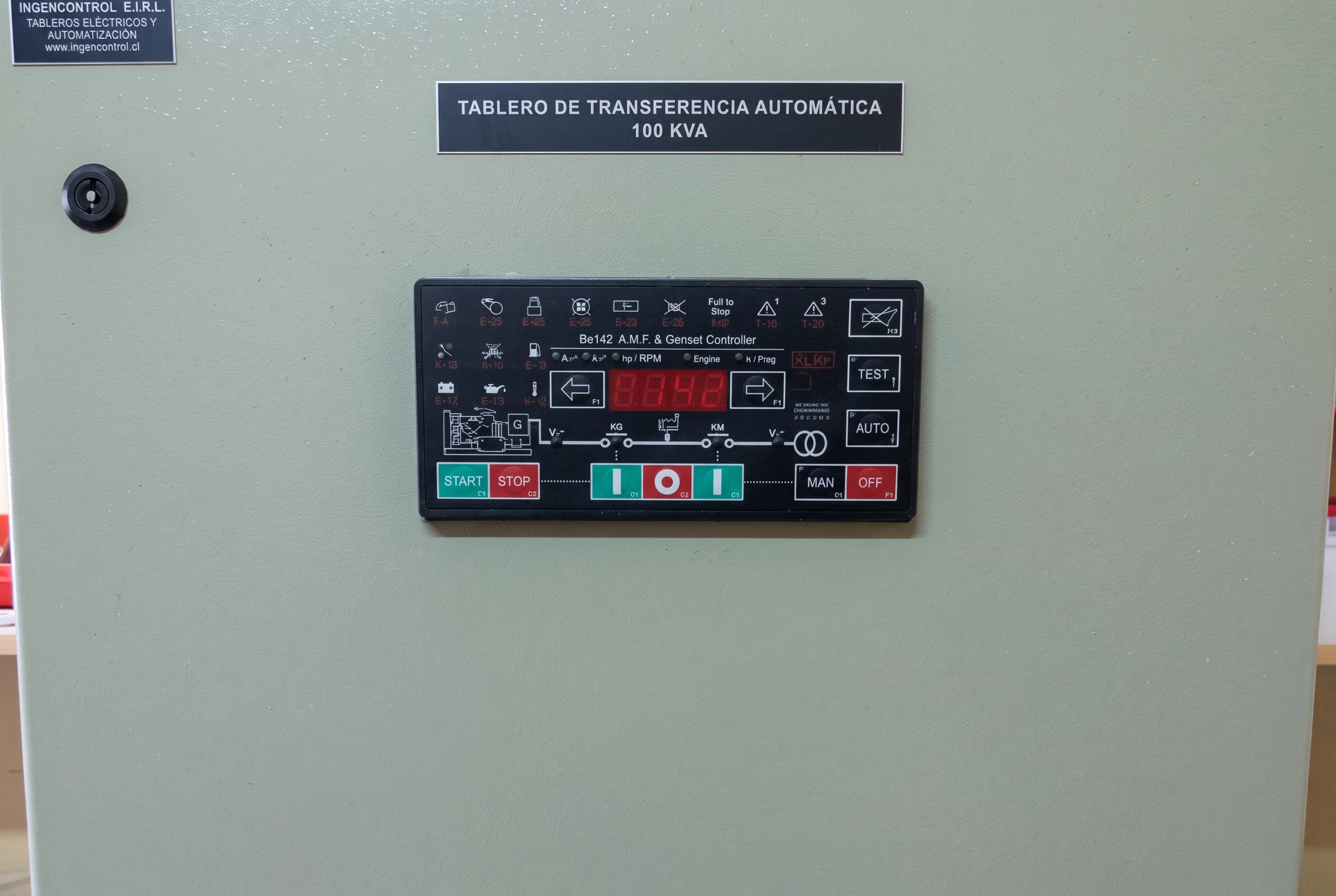
A generator without automatic transfer is a machine waiting for someone to turn it on. The ATS (Automatic Transfer Switch) is the component that detects a grid failure, orders the generator set to start and switches the load without human intervention. It is, literally, what turns a piece of equipment into an emergency power system.
How it works, step by step
The ATS continuously monitors the voltage and frequency of the utility grid across the three phases. When it detects a failure — loss of grid, voltage drop below the threshold, or loss of phase — it waits a short confirmation time (so it does not react to micro-outages), sends the start signal to the generator and, once the generator reaches stable voltage and frequency, transfers the load from the grid to the unit.
When the grid is restored, the ATS verifies that it is stable for a configurable time, returns the load to the grid, and keeps the generator running for a few minutes unloaded to cool the engine before shutting it down. The entire cycle happens without anyone touching a switch.
How long is the outage with an ATS?
The full sequence — detection, confirmation, engine start, stabilization and transfer — typically takes between 5 and 15 seconds depending on the equipment and configuration. In well-tuned transfers the outage does not exceed 10 seconds.
That interval is acceptable for most buildings, industries and commercial sites, but not for processes where a few seconds without power cause loss: operating rooms in surgery, data centers without sufficient UPS, continuous industrial processes. In those cases the answer is not a faster ATS but a UPS that covers the transition, or a paralleling/synchronizing system.
When it is mandatory or indispensable
RETIE requires suitable switching means and protections for installations with emergency generators, and the applicable code (NTC 2050, articles 700 and 701) regulates emergency and legally required systems, including automatic transfer for emergency loads in buildings with public occupancy, healthcare and similar uses.
Beyond the regulatory requirement, an ATS is indispensable in practice when: the facility operates at night or without permanent staff, the process cannot tolerate waiting for someone to arrive and start the generator, or there are loads such as elevators, fire-protection systems or refrigeration that must come back within seconds.
What to check when specifying an ATS
- Rated current and short-circuit capacity compatible with the installation.
- Number of poles: 3 or 4 poles depending on whether the neutral is switched (relevant with multiple grounding systems).
- Type of switching: open transition (break-before-make), the standard type, or closed/delayed transition for special applications.
- Adjustable time delays for start, transfer and re-transfer.
- Signals and contacts for remote monitoring and integration with BMS or SCADA.
- Electrical and mechanical interlock that prevents connecting the grid and the generator simultaneously.
ATS vs. manual start: the real math
A manual start requires detecting the outage, walking to the engine room, checking levels, starting the unit, stabilizing it and switching over with a manual panel. In the best case, with trained staff on site, that is 10-20 minutes; without permanent staff, the outage lasts as long as it takes someone to arrive.
For an operation that bills by process hour, a single nighttime contingency without an ATS usually costs more than the complete switchgear. That is why, except for occasional low-criticality applications, we recommend automatic transfer as an integral part of any emergency power installation.