
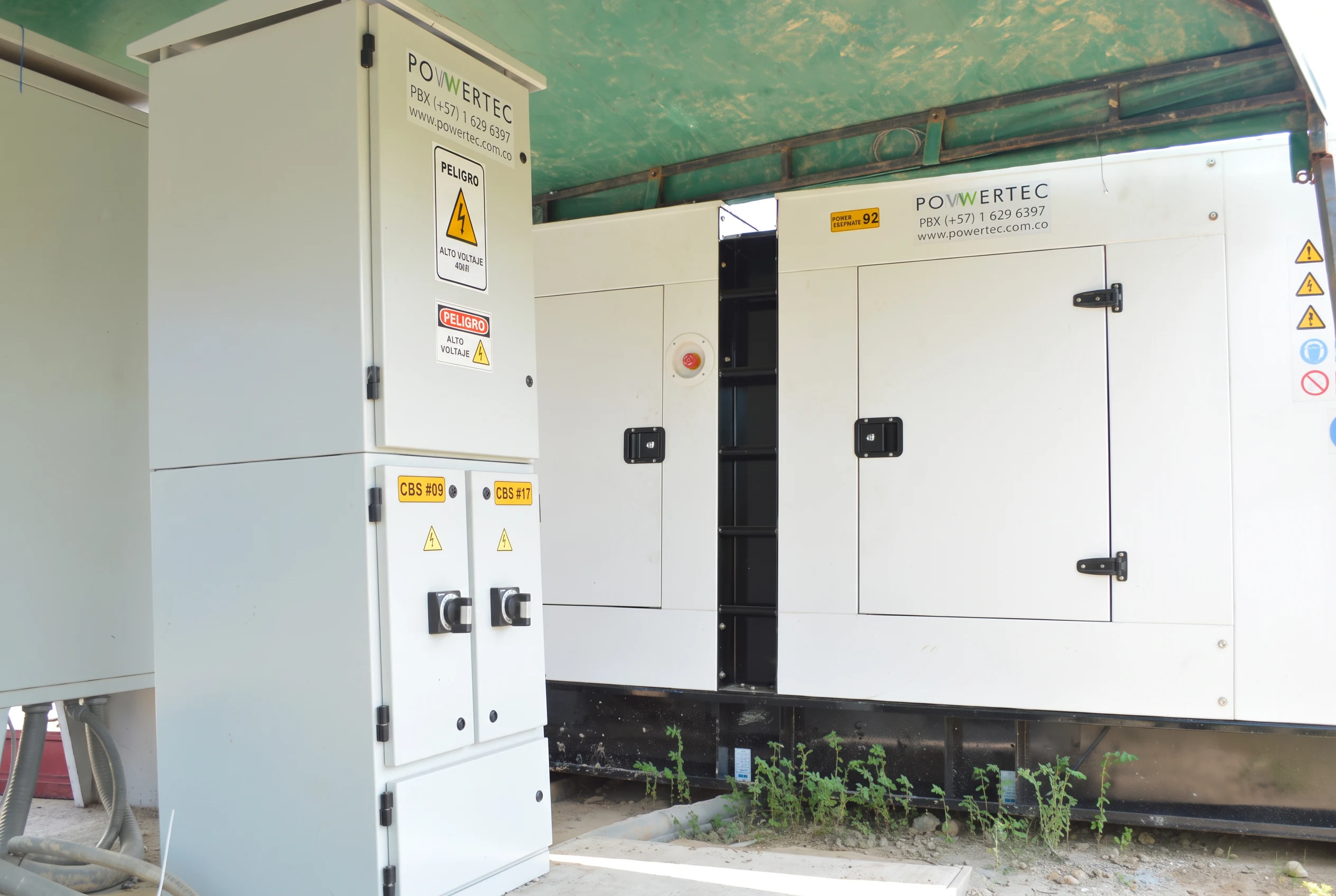
Both switchgear types answer the same question — what happens when the power source fails — with different philosophies. Automatic transfer switches from one source to another accepting a brief outage; paralleling couples two or more sources so the load never sees an interruption. Choosing between them defines the entire backup architecture.
What each one does
The ATS operates on exclusion logic: the load is connected to the grid or to the generator, never both. When a failure occurs it transfers from grid to generator in 5-15 seconds and returns the load once the grid is back. It is a simple, robust and economical solution.
Paralleling switchgear operates on coupling logic: it precisely matches voltage, frequency and phase angle between two sources and connects them in parallel without an outage. From there it allows operating several generators sharing the load, bringing units in and out according to demand, and performing transfers without interruption.
The difference that matters: the outage
With an ATS there is an outage of seconds on every switch. For most installations — buildings, retail, agribusiness, most of industry — that outage is invisible to the process or is absorbed by the equipment.
With paralleling switchgear the transition can be a zero-outage transition: the backup generator starts, synchronizes with the faulted unit or with the grid, gradually takes the load, and the previous source drops out without the voltage being interrupted. This is the configuration for operating rooms, data centers, continuous-process plants and large live events.
Paralleling = adding capacity and redundancy
Beyond continuity, paralleling switchgear enables two capabilities the ATS does not offer. The first is scaling: several generators in parallel add up capacity, so an 800 kW operation can be covered with four 250 kVA units instead of a single machine, with advantages in maintenance, spare parts and part-load efficiency.
The second is N+1 redundancy: sizing the system with one more unit than strictly necessary. If one generator fails or goes into maintenance, the remaining units take the full load without an outage. In audiovisual production and events this is the standard configuration, because the margin for error is zero.
Cost and complexity
Paralleling requires compatible generators (speed and voltage regulators suited for parallel operation), synchronizing controls, additional protections and more sophisticated commissioning engineering. The total system cost can double or triple that of an ATS-based scheme.
That is why the recommendation is based on criticality: if a 10-second outage has no serious consequences, the ATS is the right answer and there is no reason to pay more. If the outage costs product, data, patient safety, or an event in front of thousands of people, paralleling is not a luxury but the appropriate design.
Practical decision rule
- Acceptable 5-15 second outage → ATS.
- Zero-outage requirement → paralleling (with UPS for the initial transition).
- Growing or modular power need → generators in parallel with paralleling switchgear.
- Mandatory continuity if one unit fails → N+1 paralleling.
- Simple backup for a single critical load → ATS with a properly sized generator.